
Showing posts with label zlife education. Show all posts
Showing posts with label zlife education. Show all posts
Monday, 1 June 2015

Thursday, 21 May 2015
5th Grade Science Project Idea for kids
5th Grade Science Project Idea #1
Make your own Hot Air Balloon
Hot Air Balloon is a an awesome science experiment to demonstrate that hot air is less dense than cold air and how this principle was used to fly people in the 18th century and had become the first flying machine.
Kids can build a working model of a Hot Air Balloon with simple materials: Plastic Poly Bag, Aluminum Foil, Candles, Straws and Glue.
Step-by-Step Instructions along with the materials required are available in the Video below:
Step-by-Step Instructions along with the materials required are available in the Video below:
Working Principle of Hot Air Balloon
A hot air balloon consists of a bag called the 'envelope' which contains the air heated by the flame of the candles at the bottom. The bottom of the envelope is open and as the temperature of the air rises - the warm air starts going towards the top of the balloon. This process is called convection. We see it in liquids - when we heat water, the hot water goes up and the cold water comes down. This happens as the density of warm air is less than the density of cold air. This is because, when the air is heated, the air molecules start to move more randomly as heat gives them more energy and they are spaced far away from each other which lowers the density.
Even though the bottom of the envelop is open, the warm air does not escape as it is trapped by the poly bag towards the top.
Now the question is, since we know whats happening inside the balloon/envelope -
This can be checked when the kids conduct this experiment and try it with different number of candles and analyse what works out the best.
Even though the bottom of the envelop is open, the warm air does not escape as it is trapped by the poly bag towards the top.
Now the question is, since we know whats happening inside the balloon/envelope -
Why does it fly ?
The balloon will fly only when the density of the warm air inside the balloon + weight of the envelop + weight of the candles and straws is less than the density of the air around/outside the balloon.
This can be checked when the kids conduct this experiment and try it with different number of candles and analyse what works out the best.
Any Questions ?
Get in touch with us from our website www.zlifeeducation.com and email us the pictures/recordings of your experiment at our email ID mentioned on the website and we would be glad to assist you with your questions.
More information on Fun Science Experiments for Kids to do at Home :
This experiment along with many others - are a part of the Monthly Science Box Program of Zlife Education where kids aged 7 - 12 yrs get new tools and experiments shipped every month at their door step .
100+ Fun Science Experiment Videos are also available at our You Tube Channel : Science with Zlife Education.
Saturday, 16 May 2015
Fun Science Experiments for Kids to do at Home : Monthly Science Box - Part 1
What is Monthly Science Box ?
Monthly Science is a Subscription Box for kids age 7 - 11 years. Each month new box with new science experiments is delivered to your door step.Kids can conduct the science experiments at home with the tools, materials and resources provided in the Box.
Activities from the Box
Each box contains 4 Hands on fun science activities that the kids can do at home. There are step by step instruction videos available on Youtube. Click here to view the Videos on You Tube of the Science activities from the Box for kids.
Each box has a new theme/topic and experiments for the child The theme range from construction and engineering, rocketry and aero flight, microscope, astronomy , chemistry and colors.
Each box comes with tools, gear and other resources - which the child can use even for the experiments beyond the box. This way the child builds his own mini science lab over time.. This empowers the child to build his science fair project in school or other wise as interest and learning. One of the upcoming topics of this blog is 5th grade science project.
Each box has a new theme/topic and experiments for the child The theme range from construction and engineering, rocketry and aero flight, microscope, astronomy , chemistry and colors.
Each box comes with tools, gear and other resources - which the child can use even for the experiments beyond the box. This way the child builds his own mini science lab over time.. This empowers the child to build his science fair project in school or other wise as interest and learning. One of the upcoming topics of this blog is 5th grade science project.
How to Order
Any parent can choose any one of the 3 available subscription plans from the website www.zlifeeducation.com . Click on Enroll Now - buy the subscription and get the box delivered to you as per the plan.
Consult any of our Science Faculties : Call our office at 11 - 41740424 and get to know more.
Tuesday, 28 April 2015
Balloon Powered Car : Monthly Science Box Experiment for Kids to do at home
Science Experiment for Kids to do at home. Build your own car that works with Balloon and Newtons 3rd Law of Motion. This experiment is part of activity from Monthly Science Box for Kids by Zlife Education. Order your box at www.zlifeeducation.com
Friday, 14 February 2014
Heart of the Atacama
Heart of the Atacama!
(News courtesy ESA)

(News courtesy ESA)
This satellite image shows the heart-shaped Miscanti lake and smaller Miñiques lake in northern Chile.
The lakewater is brackish – meaning that it’s saltier than freshwater, but not as much as seawater. This is due to the salinity in the soil. Chile’s largest salt flat – the Salar de Atacama – lies to the west (not pictured).
Two partially snow-covered volcanoes can be seen above and below the lakes on the right, while plains stretch out to the west in a nearly vegetation-free environment.
The area pictured is part of the Atacama Desert, which runs along part of South America’s central west coast. It is considered one of the driest places on Earth, as moisture from the Amazon Basin is blocked by the Andes to the east, as well as from the Pacific Ocean by the Chilean Coastal Range to the west. Pacific Ocean currents and wind circulation also play a major role in the desert climate.
Because of the Atacama plateau’s high altitude, low cloud cover and lack of light pollution, it is one of the best places in the world to conduct astronomical observations and home to two major observatories.
Some areas of the desert have been compared to the planet Mars, and have been used as a location for filming scenes set on the red planet. Just last year, ESA tested a self-steering rover in the Atacama, which was selected for its similarities to martian conditions.
The Japanese Advanced Land Observation Satellite, or ALOS, captured this image on 30 May 2010.
Thursday, 22 August 2013
Herschel solves mystery of Jupiter's water!!
(news courtesy ESA)
 |
| Shoemaker-Levy 9 impact site G |
24 April 2013
Jupiter, the largest planet in the Solar System, is mostly made of the gases hydrogen and helium. Tiny amounts of water have been found in its upper atmosphere, but, until now, no one was sure where this water came from. The answer to the long-standing mystery has been given by ESA’s Herschel space observatory, the most sensitive infrared telescope ever launched. Herschel has found conclusive evidence that the water was delivered by multiple comet impacts in July 1994!
Collisions with incoming cosmic debris are a continuous threat to the planets of the Solar System, including Earth. However, few impacts have actually been observed by scientists. The first direct observation of such an event occurred at Jupiter, 19 years ago. Astronomers watched in astonishment as 21 pieces of comet Shoemaker-Levy 9 plunged into the planet’s upper atmosphere and exploded.
 |
| Water in Jupiter's Atmosphere |
ESA’s Infrared Space Observatory, launched in 1995, was the first to detect and study water in Jupiter's upper atmosphere. Scientists were able to exclude an internal source, such as water rising from below. But if the water was delivered from outside, where did it come from?
It was widely speculated that comet Shoemaker-Levy 9 may have been the origin of this water, but direct proof was missing. Now Herschel’s sensitive infrared eyes have solved the mystery. The space observatory has found 2-3 times more water in the southern hemisphere of Jupiter than in the northern hemisphere. The traces of water are only found at high altitudes and most of it is concentrated around the sites of the 1994 comet impacts.
Even more detailed observations of the gases that make up Jupiter’s massive atmosphere will be made by ESA’s JUICE mission, which is planned for launch towards the giant world in 2022.
Comets can do so much and more!!

Wednesday, 14 August 2013
Glimpse of our new product launch: Science Shows for Primary
6th August 2013: Kids of Amity International School, Gurgaon enjoy the demo launch of Science Shows!!


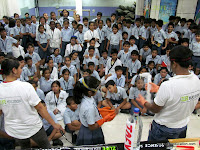


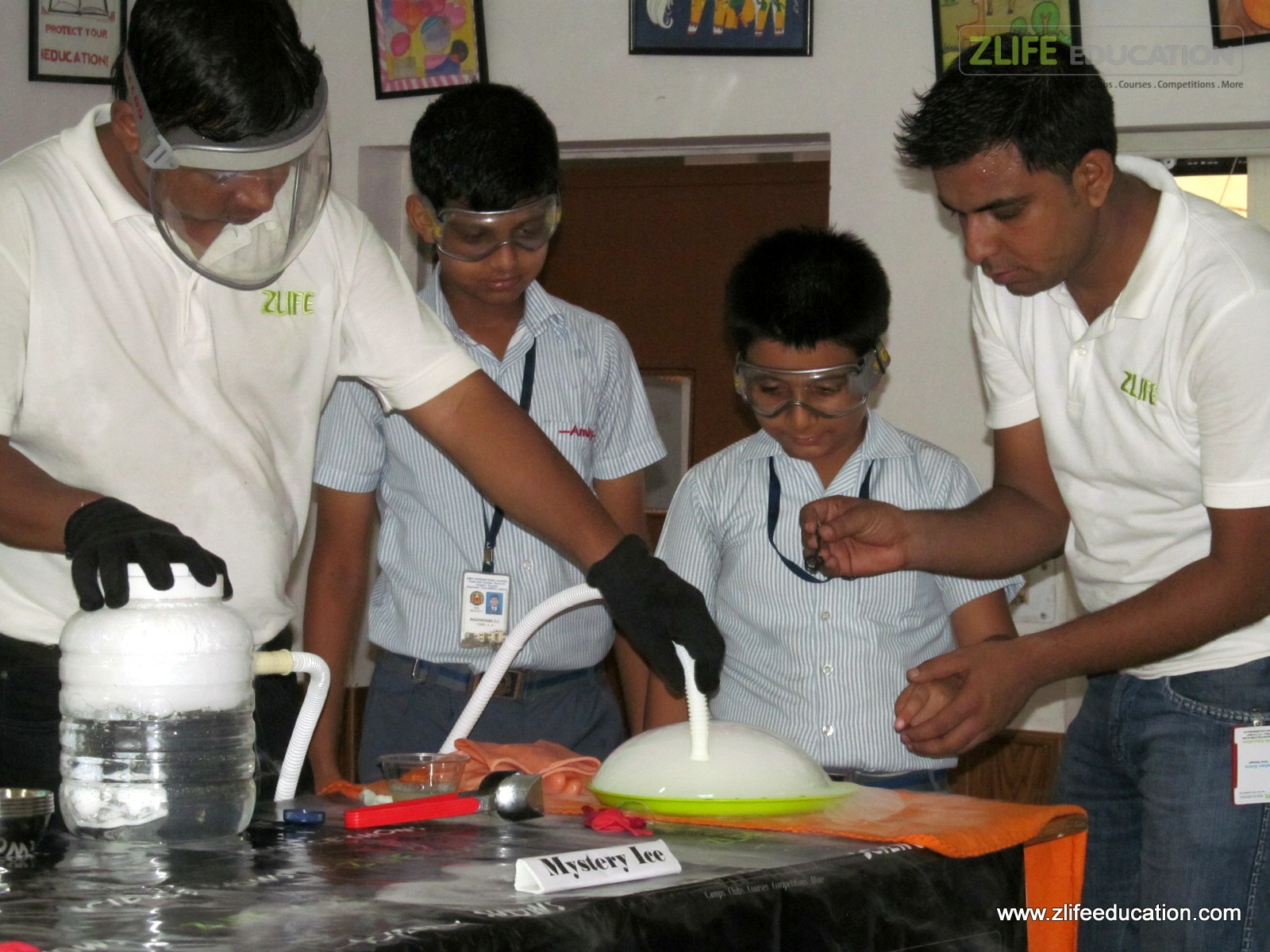


Science Shows has been especially designed for classes I - V, it gives students an interesting
combination on Hands on Activities and interactive science demos wherein kids learn interesting concepts of Physics, Chemistry & Astronomy. This
program is designed to inculcate an interest among primary students for science
related subjects.
Cheers Team Zlife
Monday, 5 August 2013
Here come the Perseids!
Here come the Perseids!
(news courtesy ESA)
(news courtesy ESA)
 |
| Perseids meteor shower (Credits: Ali Jarekji, Reuters) |
1 August 2013
Sky watchers will be in for a treat in mid-August, when the annual Perseid meteor shower reaches its peak! If you have never before seen a meteor, this is the ideal opportunity. The shower lasts from late July until 20 August, with maximum activity expected between 11 and 13 August. The sky will be dark, as the crescent Moon will be setting below the horizon in mid-evening. And the night should also be warm, so you won’t even need to wrap up! Just keep away from bright lights, let your eyes adapt to the darkness, then lie back and stare at the sky.
Perseids are named after the constellation of Perseus, from which they seem to radiate outwards. However, they can appear anywhere in the sky. The best direction to look is wherever your sky is darkest, probably straight up. The constellation is low in the north-northeast before midnight and rises higher above the horizon during the early morning. The shower is best observed from 11 pm or midnight onward, when you may see 60-100 meteors per hour.
 |
| Credits: NASA
The Perseids are sand - to pea - sized bits of rocky debris that were ejected long ago by comet Swift-Tuttle. The comet is slowly disintegrating as it orbits the Sun. Over the centuries, its crumbly remains have spread along its orbit to form a stream of particles hundreds of millions of kilometers long.
Earth’s path around the Sun carries us through this comet debris every mid-August. The particles, or meteoroids, are travelling at 60 km per second with respect to Earth. When one of them hits the upper atmosphere, it creates a white-hot streak of super-heated air. Occasional brighter ones may survive for several seconds, leaving short-lived trails of glowing smoke and gas.
The Perseids are ideal for digital imaging. Attach your camera to a tripod, preferably with a wide angle lens and a high ISO (darkness) setting. Keep the shutter open for 10-15 seconds at a time (longer in a really dark place). With a bit of luck, you should capture one or more Perseids streaking across the photo!
Enjoy observing the August Night Sky!!
|
Thursday, 13 June 2013
Space & Science Workshop Conducted at Delhi Public School, Nashik
Our team from Delhi was recently in Nashik to conduct a Science Workshop at the newly inaugurated Delhi Public School (Nashik). The school is nicely situated at the outskirts of the city with a fine infrastructure and a very cordial staff.
Around 40 students of 4th& 5th Standard attended this 3 day workshop. The aim of the workshop was to impart learning by involving kids in various hands on activities related to space and science like Circumference of Earth, Sun Spots Observation, Hydro Rocketry & Evening Sky Observation. Learning is always fun when you can practically apply what is taught to you!!
Day 1: 22nd May’13
Around 40 students of 4th& 5th Standard attended this 3 day workshop. The aim of the workshop was to impart learning by involving kids in various hands on activities related to space and science like Circumference of Earth, Sun Spots Observation, Hydro Rocketry & Evening Sky Observation. Learning is always fun when you can practically apply what is taught to you!!
Day 1: 22nd May’13
The workshop started around 11:00 A.M and continued till 3:00 P.M, the first topic covered was Circumference of Earth – Kids used Eratosthenes primitive yet effective way to evaluate COE.
Later the kids observed Sun Spots using Sky Watcher EQ 3-2 (telescope) securely covered by a solar filter as we should not see the sun through naked eye. (Viewing the sun directly through naked eye can permanently damage the eyes).
Later the kids observed Sun Spots using Sky Watcher EQ 3-2 (telescope) securely covered by a solar filter as we should not see the sun through naked eye. (Viewing the sun directly through naked eye can permanently damage the eyes).

Day 2: 23rd May’13

On the second day of the workshop the kids were introduced to Hydro Rocketry. The session started with a presentation where they learnt about the dynamics and trajectory of Rockets.

Later the students applied the concepts learned during the presentation by designing their own Double Bottle Rockets. The whole group was divided into 4 teams while designing the rockets. The kids were at their creative best and had lots of fun designing their own rockets.


The last and the most exciting step was to launch those rockets. This final step hardly lasts a few minutes but is the most fun when you see the rockets going high above the ground and crashing 100 feet away!!


Day 3: 24th May’13
The last day of the workshop had the most interesting part - Evening Sky Observation which started around 6:00 P.M and went on till 9:00 P.M. The kids observed Saturn and Moon using the Sky Watcher EQ 3-2. On this final day the kids were accompanied by their parents and even the parents actively and excitedly participated in observing these celestial objects.


During the first half of this workshop the kids were given a presentation to make them understand the working and handling of a telescope. Later the kids were divided into 4 teams and each team was given a 3.5 inch reflector telescope which they handled themselves and observed Saturn and Moon. As expected the kids and their parents were in awe when they observed the crater’s on the Moon and the Rings of Saturn.


Lastly there was a small closing ceremony where everybody together celebrated the successful completion of the workshop. We presented the kids with certificates & medals, and the school was given a memento and in return our team was presented with return gifts as an appreciation gesture.


Monday, 13 August 2012
Our Dear Uranus, How Is It Doing?
1. Uranus is the coldest planet in the Solar System
Uranus is the 7th planet from the Sun, orbiting at a distance of 2.88 billion km. But it’s still much closer than Neptune, which averages a distance of 4.5 billion km from the Sun. But there’s something strange about Uranus – it’s really cold. Unlike the other large planets in the Solar System, Uranus actually gives off less heat than it absorbs from the Sun. The other large planets have tremendously hot cores, and radiate infrared radiation. But something made the core of Uranus cool down to the point that it doesn’t radiate much heat. The temperature of the cloud tops on Uranus can dip down to 49 K (-224 °C).
2. Uranus is turned over on its side
All of the planets in the Solar System rotate on their axis, with a tilt that’s similar to the Sun. Sure, the planets are a little tilted. For example, the axis of the Earth’s rotation is tilted 23.5 degrees away from the Sun’s plane; and Mars is similar. But the tilt of Uranus is 98.3401 degrees. In other words, the planet is rotating on its side. All the planets look a bit like spinning top as they go around the Sun, but Uranus looks more like a ball rolling on its side.
And this leads to another strange fact about Uranus…
And this leads to another strange fact about Uranus…
3. Summer on Uranus lasts one long day – 42 years
A day on Uranus is only about 17 hours. But the tilt of Uranus works out so that one pole or the other is usually pointed towards the Sun. This means that a day at the north pole of Uranus lasts half of a Uranian year – 84 Earth years. So, if you could stand on the north pole of Uranus, you would see the Sun rise in the sky, circle around for 42 years, and finally dip down below the horizon. Then you would have 42 years of darkness.
4. Uranus is the second least dense planet
The least dense planet in the Solar System is Saturn. In fact, Saturn has such a low density that it would float on water if you could find a pool large enough. Uranus comes in second as the least dense planets in the Solar System. The density of Uranus is only 1.27 g/cm3. In other words, Uranus would sink in water (water is 1 g/cm3. This low density has an interesting side effect. Even though Uranus is 14.5 times as massive as the Earth, you would only experience about 89% the force of gravity if you could stand on its surface.
5. Uranus has rings
Obviously Saturn has rings; you can see them in any backyard telescope. But Uranus has the second most dramatic set of rings in the Solar System. Unlike Saturn’s particles which are made of bright ice, the rings of Uranus are very dark. They’re also narrow, only measuring a few km wide. Astronomers think that the rings of Uranus are very young, and probably formed relatively recently, and not with the planet.
6. The atmosphere of Uranus is boring… or is it?
Seen in visible light, Uranus is a boring blue ball. You can’t see the amazing bands of clouds and storms that we see on Jupiter and Saturn. But look closer in other wavelengths, like infrared, and you’ll see that Uranus does have bands and cloud patterns. Early observations of Uranus didn’t show anything, but improved telescopes in the 1990s showed that Uranus has bright regions in its atmosphere. Some of these clouds only last for hours, while others have been around since the Voyager flyby in 1986. Astronomers have also been able to chart the wind speeds on Uranus, and have found they can 250 mtr/s.
7. Uranus has 27 moons
Like all of the giant planets, Uranus has its share of moons. Astronomers now count 27 natural satellites. But they’re actually a pretty lightweight group of moons. If you could add up all their mass, they would account for less than half the mass of Triton, Neptune’s largest moon. The largest moon, Titania, has a diameter of about half the diameter of the Earth’s moon.
8. Uranus was the first planet discovered in the modern age
Most of the planets are visible to the unaided eye, and were known in ancient times. Uranus was the first planet discovered after the invention of the telescope. It was first recorded in 1690 by John Flamsteed, who thought it was a star in the constellation Tauri. But it wasn’t until Sir William Herschel made his observations in 1781 that astronomers finally realized it was a planet. Herschel originally wanted to call Uranus “George’s Star” after King George III, the astronomical community settled on Uranus, and the name stuck.
9. You can see Uranus with the unaided eye
You might be surprised to know that you can see Uranus without a telescope; just with your eyes. At magnitude 5.3, Uranus is just within the brightness scale that a human eye can perceive. Of course, you’ve got to have extremely dark skies and know exactly where to look to see Uranus. Get a pair of binoculars, and Uranus is possible to see even in brighter skies. It’s amazing to think that Uranus was right there, ready for anyone to discover, but nobody knew what to look for.
10. Uranus has only been visited once
Only one spacecraft in the history of spaceflight has ever made a close approach to Uranus. NASA’s Voyager 2 zipped pass Uranus in January, 1986, coming within 81,000 km of the surface of Uranus. It took thousands of photographs of Uranus and its moons, and then sped off onto towards its next target: Neptune. No other spacecraft have ever been sent towards Uranus, and there are no plans to send any more. So get used to the few pictures we’ve got.

Follow us on Facebook
Thursday, 7 June 2012
IAYP Bronze Award Program
Hopetown Girls School, Dehradun completed their "Adventurous Journey" with us at Camp Redstone
4th May - 6th May 2012
 |
| IAYP Bronze Award Program, Hopetown Girls School, Dehradun |
Enjoy the pictures!
Friday, 6 April 2012
OCL (Outside Classroom Learning) Program For Hopetown Girls School, Dehradun
25th March - 29th March 2012
MID TERM’S a few years ago this word was associated with quarterly exams, however Hopetown School has given this word a new meaning, now it’s their annual outing for students to various locations. And this time the girls of Class VIII landed on our very own Camp Redstone.

Super charged up the girls arrived at Camp Redstone on 25th March’12 around 9’O clock in the morning least expecting what’s in-store for them. After a bit of briefing regarding the camp and its location the girls went to have their breakfast. Later they were divided into 6 teams of 10 students each, and were asked to design their team flags and slogans, this they did with full enthusiasm and spirit and created beautiful flags just like you’d imagine girls would do, all glittery and jazzed up!

After a little further briefing about the day’s activities and Do’s & Don't at the camp, the kids went exploring the Camp surroundings with the camp manager. After lunch the students learnt about Rope Knots, various types and its importance and where to use it practically. In fact to test the same they further went on for their next activity “Raft Building”, for this 2 teams were grouped together and were supposed to collectively build a raft and further test the rafts durability at the Camps very own private lake. The excitement for this activity was noteworthy!
After munching on their evening snacks the girls went on for team games testing their leadership, coordination and unity. After dinner they went on for their last activity of the day an “experiment on stalactites and stalagmites”.
Day 2, started early at 5:45 AM with a lot of cribbing and light exercises followed by happy faces after seeing breakfast being served. After breakfast, again a lot of cribbing and health excuses, since today was their day long hike (The kids were not aware that the hike was cut short and they were to return to camp earlier than planned). Anyhow they march on carrying the material for lunch prep since they were suppose to cook their own meals today (unknown of the surprise hidden MAGGIE). The trek led them to a government school where they interacted with the school kids and teachers, getting entertained by the students of the school by their dance and music performances and later on doing the same for those kids. On the way back, we finally halted at the spot where the teams were suppose to cook their Maggie, it was amazing to see what a bunch of hungry kids can do with their packs of Maggie, just one word ‘DELICIOUS’. Energized again we head back to the camp for yet another wilderness survival activity “Shelter Making”, needless to say the girls again did a wonderful job.

Today after these activities the teams were given different camp tasks to perform like managing Food, House Keeping, Bonfire, Leave No Trace and Media, a time slot was allotted for these camp management tasks and in the span of 3 days all the 6 teams were to take care of all these activities one by one. It was amazing to see the dedication with which the girls performed all these tasks.
Later after dinner, 3 teams went on for their Night Sky Observation all excited to spot Saturn’s rings and the craters on Moon, learning about constellations and other heavenly objects. The other 3 teams chose to watch a movie however later decided to hit the bed early since they had to wake up early the next day for their Bird Watching session.
Day 3, started with an early morning wake up call for the 3 teams who had Bird Watching today, however today there was no cribbing. The girls spotted 18 varieties of birds and returned happily to the camp to have breakfast.

After breakfast, different teams went for different activities like ‘Nature Furniture’, ‘Rocketry’, ‘Adventure Activities’, Circumference of earth and directions using shortest shadow method and finally doing the ‘Treasure Hunt’ in between returning for lunch, these activities carried on till the evening. Later tonight there was a surprise party for the girls of Hopetown combined with Birthday celebrations of a classmate. The energy with which they danced, no one could say that these girls had a tiring and hectic day. Finally they were made to go to bed at 11:00 P.M by their teachers since they were again supposed to wake up early the next day.


Day 4 went on almost the same way as day 3 till lunch and later after lunch everybody headed out for the ‘Cave Exploration Trek’, the girls were tired yet full of spirit and they went ahead to explore the Cave with the Stalagmites and Stalactites formation, having yet another informational journey. The girls returned to camp just in time for evening snacks later followed by camp tasks and then submitting their journals. Today again we had a clear night sky and the teams went onto observe the planets and constellations.

Day 5 was the final day at Camp Red Stone for the girls of Hopetown School. 3 teams went ahead for their final stretch of activities ‘Rocketry’, they made their own rockets and successfully launched them, understanding the principals of good designing and aerodynamic efficiency. Finally around 11:30 A.M to wind up the trip, they had their prize distribution and luncheon.

Wednesday, 30 November 2011
Bal Bharati Public School, Noida Sec-21, Night Sky Observation At Camp Mustang

On 28th
November 2011, Zlife Education organized a night sky observation session, one
of 11 sessions of the astronomy clubs for Bal Bharati Public School, Sec 21 Noida.
We departed from
school at around 1700 hrs on 28th with 25 out of 27 club members and
three respected school faculties. We reached camp mustang at around 1930hrs
where kids were shown to their respective tents and were given an introduction
about the camp, where they will be spending next 10 hours pursuing the night
sky observation.
For starter kids
had some rest following it was snack time when kids enjoyed the cookies and
tea/coffee. At around 2030hrs, kids were divided into two groups, one of which
went for the solar walk quiz and the other went to the observational area to
view Jupiter and its moons with a 6’’ reflector type equatorial mount
telescope.

At around 2130 hours dinner was served with a variety of starters
including salads followed by main course dishes like paneer, aaloo gobhi and
dal finally topping up the appetite with a nice desert, kheer.
After a break,
at around 2230 hrs, kids were introduced to the night sky objects and methods to
view the sky effectively in the orientation session, where kids learned the
basic concepts like zenith, meridian, horizon, ecliptic etc and a depth
understanding of reading the sky map, i.e. the planisphere. The session went
for an hour and a half followed by a fifteen minute break.

At around 0030hrs on
29th, kids were taken out to the observational area to develop a
practical understanding of the theoretical sky knowledge gained in the
orientation session, for next 2 hours kids saw and understand the concept of
constellations and viewed pleides star cluster and orion nebula through a
telescope.
By the end of the class, students understood the concept of star
clusters, nebulae and constellations. At around 0245hrs, a health drink was
served to the kids following a 15 minute break. Sketch what you saw
competition, was played by the kids at 0315hrs in which they had to draw the
image of the sky objects, they saw in the sky.

After this, kids were let off to
their camps to rest for an hour, while the arena was setting up for the medal
distribution. Kids were wide awake and freshened up by 0530hours when the
medals were distributed to the respective teams on the basis of their
performance in the competitions.

We departed the camp at 0700 hrs and reached
the school at around 0930 hrs. Where and when the night sky session was concluded.
Pictures can also be checked at our Facebook Page
Subscribe to:
Posts (Atom)